







































by Mick Lavin, Coach, Agile Coach, Mentor
We’ve spent this series examining where AI and the world of work are right now, the capabilities, the failures, the paradoxes, and the practical frameworks for getting things right. As a final article, it’s worth lifting our gaze to the future horizon.
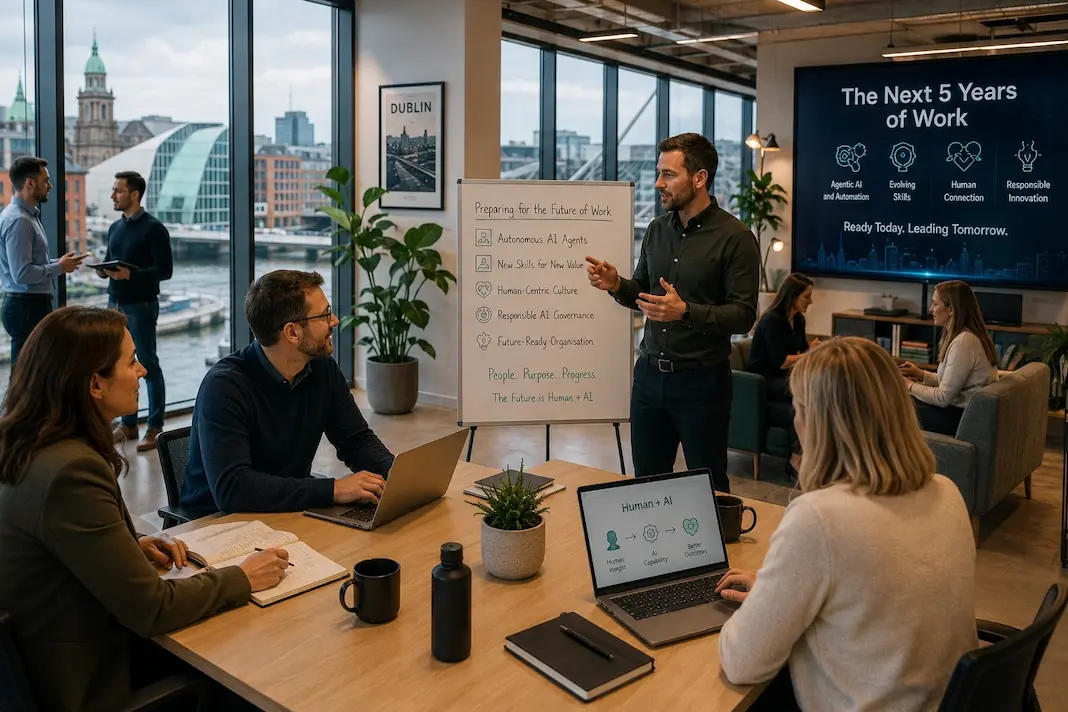
Because the pace of change isn’t slowing. The generative AI tools that already feel challenging to govern and deploy are, in many ways, the simple version of what’s coming. Over the next three to five years, several shifts will fundamentally reshape how organisations structure work, develop talent, and manage the relationship between human and machine capability.
For HR and Legal professionals, early awareness of these shifts is the necessary preparation for the strategic and regulatory landscape you’ll be navigating.
Shift 1: The Rise of Autonomous Agentic Workflows
The AI tools most organisations are grappling with today are, broadly speaking, responsive. You ask a question, you get an answer. You provide a prompt, you get an output. A human initiates every interaction.
The next generation has already landed. Autonomous agentic AI systems are designed to execute complex, multi-step tasks across integrated software ecosystems, independently, continuously, and without a human initiating each step.
Imagine an AI agent that monitors incoming employment tribunal correspondence, retrieves relevant policy documents, drafts initial response frameworks, flags cases that require urgent legal review, and updates the case management system – all without waiting for a human to kick off each step.
The productivity potential is significant. So are the governance challenges.
As these agentic systems proliferate, the primary role of the human knowledge worker will shift toward “agent orchestration”, managing the parallel execution of multiple autonomous AI systems. This requires rapid context-switching, architectural oversight, and the ability to spot when an autonomous system is heading in the wrong direction before the consequences become serious.
For HR and Legal teams, the governance implications are acute. Autonomous agents touching employment data, contributing to employment decisions, or acting in legally sensitive workflows need robust oversight frameworks, and organisations that don’t build them proactively will build them reactively, in response to an incident.
Shift 2: The Commoditisation of Technical Skills
The technical skills that have commanded premium compensation over the past decade, software coding, data analysis, and certain forms of structured legal drafting, are facing rapid commoditisation.
The emergence of what’s called “vibe coding”, software development driven by natural language instructions rather than syntax, is already visible. Junior developers are producing functional code through AI interaction rather than manual programming. The implication is not that developers disappear, but that the type of developer who commands a premium changes fundamentally.
The same dynamic is playing out in Legal and HR functions. Routine drafting, standard policy generation, and templated correspondence are increasingly within AI capability. The work that remains distinctly premium is the work described throughout this series: strategic judgement, contextual nuance, ethical navigation, and authentic relationships.
For organisations planning their workforce over a three- to five-year horizon, this means two things. First: don’t build your talent pipeline around technical skills that are commoditising. Second: invest aggressively in the human capabilities that are appreciating in value, the ones we called “Human Super Skills” in an earlier article of this series.
Shift 3: A New and More Consequential Digital Divide
There is already a meaningful gap between organisations that are extracting value from AI and those that are stuck in pilot purgatory. Over the next three to five years, that gap will widen, and it will become effectively insurmountable for those that don’t experiment and implement now.
Crucially, as the research notes, this divide will no longer be predicated primarily on financial access to technology. Foundational AI models are becoming increasingly commoditised, available to organisations of every size at accessible price points*. The divide will be determined instead by organisational and epistemic capability: the ability to deploy AI effectively without falling victim to the jagged frontier, drowning in workslop, or failing governance obligations.
This has direct implications for Irish and EU organisations. Larger enterprises with resources to invest in talent, governance, and infrastructure will compound their advantages. Smaller organisations that don’t have the capacity to build this capability internally will need to find it through partnerships, advisors, and networks.
*There is currently much speculation surrounding the long-term accessibility of current AI price points, with many analysts agreeing that the cost of access will rise as large AI corporations need to return profits to their shareholders.
This commercial pressure coincides with the rise of Chinese competitors and the rapid development of open-source AI models, which are becoming increasingly capable alternatives.
Amidst these dynamic shifts, organisations must remain strictly aware of their GDPR, compliance, and company data privacy limits. This has given momentum to the EU Digital Sovereignty initiative, which, while nascent, is rapidly gaining traction alongside the rise of EU-based AI solutions from Mistral, European cloud initiatives, and the enforcement of the EU AI Act.
Shift 4: The Rising Premium on Verified Human Intelligence
As AI-generated content proliferates, and as synthetic voices, images, and documentation become increasingly indistinguishable from genuine human output, there will be a growing economic premium on verified human intelligence.
Authentic human creativity. Genuine physical presence. Deep interpersonal trust. Moral reasoning grounded in lived experience. These will become rarer and, consequently, more highly valued, both economically and socially.
For HR professionals, this has profound implications for how you position human work, communicate about talent, and design roles that leverage distinctly human capabilities. The employees who will thrive in 2030 are those whose work is anchored in authentic human connection, strategic judgement, and adaptive creativity, not in tasks that AI can credibly replicate.
For Legal professionals, the premium on authentic human expertise, particularly in advocacy, client relationship management, and complex ethical judgement, will be a competitive differentiator worth explicitly cultivating and communicating.
For myself, as a Coach, there is growing ‘Competition’ from AI Coaching Bots, which leaves me a choice: Do I rage against the machine, or do I embrace the technology and integrate it into my practice to support my clients in their journey? I’ve gone so far as to create my own privacy-focused AI tools to support my clients.
Shift 5: The Regulatory Landscape Will Catch Up
Regulatory frameworks around AI in the workplace are developing and accelerating. The EU AI Act categorises certain AI uses in employment contexts as “high risk”, including systems used for recruitment, promotion, task allocation, and performance monitoring. These applications require conformity assessments, transparency obligations, and human oversight mechanisms.
This is not the end of the regulatory story. As AI becomes more embedded in employment decisions, expect:
- More specific guidance and case law on automated employment decisions under GDPR
- Expansion of employee rights to explanation and review of AI-assisted HR processes
- Increased scrutiny of AI tools in disciplinary and performance management contexts
- Potential obligations around algorithmic transparency in collective bargaining
Employment lawyers and HR compliance professionals who build expertise in this area now will find themselves significantly ahead of the curve within three to five years.
A Forward-Looking Agenda for HR and Employment Law Professionals
For HR Leaders:
- Begin your three- to five-year workforce planning with a clear-eyed view of which current role types are likely to change most significantly, and build reskilling pathways now, not in 2027/8
- Invest in governance infrastructure that can accommodate agentic AI systems, not just the prompt-response tools of today
- Make “Human Super Skills” an explicit, funded priority in your L&D strategy, not a stated value but an actual budget line
- Build relationships with legal advisors who are developing expertise in AI employment law; you’ll need them
For Legal Professionals:
- Develop working familiarity with the EU AI Act and its employment-related provisions; your HR clients will increasingly need guidance on this
- Build a practical understanding of GDPR Article 22 and its application to AI-assisted employment decisions
- Watch the emerging body of employment tribunal cases involving AI; the first significant cases are beginning to surface, and the trends will define your advice over the next decade
- Position yourself as a trusted advisor on responsible AI governance in employment contexts; it’s a differentiating expertise that few firms currently have
What Doesn’t Change
Amid all of this, it’s worth pausing on what remains constant, because it’s the anchor for everything else.
Employees will still need to feel valued, respected, and fairly treated. They will still need clarity about what’s expected of them and confidence that the systems they work within are transparent and just. When something goes wrong, as it inevitably will, they will need a human to turn to who has the authority, the empathy, and the expertise to respond.
The organisations that will define the future of work are not those that remove humans from this equation. They’re the ones that architect their AI systems around a genuine, sustained commitment to human capability, dignity, and connection.
That has always been the heart of good HR practice and good employment law. In the AI economy, it becomes more important, not less.
The Series in Summary
Across these nine articles, we’ve mapped the landscape of AI and the future of work from multiple angles:
-
AI & The Future of Work Series Introduction
- AI Capability Guide for Leaders: What AI Can (and Can’t) Do at Work
- Job Displacement & Job Transformation: What’s Happening to Jobs?
- Human Super Skills: The Most Valuable Assets in Your Organisation
- The Structural Reasons Most AI Adoption Fails
- The AI Productivity Paradox: Your Team Is Working Harder, Not Smarter
- How to Actually Multiply Productivity, Not Just Create Noise
- A Strategic AI Roadmap for Responsible AI Adoption
- The AI Readiness Checklist Every Leadership Team Must Answer Before Scaling
The common thread across all nine articles is the same: the organisations that get this right are not those with the most advanced technology. They’re the ones that combine technological capability with human wisdom, strong governance, and genuine investment in their people.
That is what good HR leadership looks like. And it’s exactly what this moment requires.
About the author
Mick Lavin is an Intercultural Coach, Executive Coach and Mentor, accredited by the European Mentoring and Coaching Council. For the past 30+ years, Mick has worked in the world of technology as a people, project, and strategic account manager in several European countries, with the US, in the Middle East, and in Asia. Mick specialises in people & leadership development and business agility in multicultural business environments, helping organisations move to a more responsive and people-centric mindset. Mick’s new project is Evolved By AI – a privacy-focused AI development company.
Mick Lavin Coaching; Evolved By AI