







































by Mick Lavin, Coach, Agile Coach, Mentor
As I sat and listened at a summit in London recently, I was struck by the promise of AI and the reality of its implementation. There were some fantastic use cases, but there were also stories of disaster with failed implementations of AI projects.
One theme, however, ran throughout the entire summit: All agreed that AI will disrupt and change how we work in the future. And not just in the knowledge work field but eventually in physical world work environments too.
With leaders in the field of AI development, leaders in business, and representatives from the World Economic Forum (WEF) speaking, several things became apparent:
- We are at the beginning of a journey that has the potential to transform the world of work.
- Productivity will increase – by a factor as yet to be ascertained.
- There are differing opinions on what the effect of AI will be on employment and employability.
While much of the impact of AI is yet to be defined and understood, several clear trends emerged.
In our local news this week, there are a number of articles and reports that discuss the impact AI is already having on employment in Ireland. Covalen featured as they layoff staff due to the jobs no longer being needed. I think in this case it is the thin end of the wedge, as the jobs in question were specifically around the training of AI such as data annotation. My feeling is these jobs were only ever fleeting.
The Business Post this week also quotes Donal O’Donoghue, managing director at recruitment agency Sanderson, who says, “What we are definitely seeing is that roles are changing – and we’re seeing that AI literacy and competence and prompt engineering are forming part of job descriptions. But we don’t see this as AI disruption – we just see this as a normal evolution of how roles are shaking out.”
While AI has some issues at the moment, progress is like a tsunami. Every week we are confronted with a new wonder, and yet there are still things we do better than AI. At the Economist AI and Business Innovation Summit, John Abel of Google asked an interesting question, “What is the human error rate?” We currently measure how much AI gets wrong, but do we measure this in humans. And if we do, will we adopt AI when it’s close enough? Or will we wait for perfection? I suspect close enough will do.
Sue Duke of LinkedIn and Devendra Jain of World Economic Forum talked about how we will remain relevant with what they termed, Human Super Skills (Adaptability, Entrepreneurship, Eagerness to Learn), but that AI literacy will be a core skill. They recognised that by 2030, 75% of job skills will change.
Over the next 9 weeks, we are going to dive deep into the implications of adopting AI in organisations large and small. This series is based on my observations at the Economist AI & Business Innovation Summit, WEF (Future of Jobs Report), LinkedIn Talent Report (Workforce Reports), and other research sources in media and consultancy.
Across the nine articles, I’ve mapped the landscape of AI and the future of work from multiple angles:
- AI Capability Guide for Leaders: What AI Can (and Can’t) Do at Work
- Job Displacement & Job Transformation: What’s Happening to Jobs?
- Human Super Skills: The Most Valuable Assets in Your Organisation
- The Structural Reasons Most AI Adoption Fails
- The AI Productivity Paradox: Your Team Is Working Harder, Not Smarter
- How to Actually Multiply Productivity, Not Just Create Noise
- A Strategic AI Roadmap for Responsible AI Adoption
- The AI Readiness Checklist Every Leadership Team Must Answer Before Scaling
- What Will AI Change About Work – Prepare Your Organisation Now
Organisations that get this right will not necessarily be those with the most advanced technology. They will be the ones that combine technological capability with human wisdom, strong governance, and genuine investment in their people.
The original idea for this series came from a few of panel discussions and conferences I attended in the last 12 months. The first was the Future Workforce Summit 2025, International Coach Federation (ICF) Germany and New York University (NYU), Berlin, this event focused on the intersection of human talent and artificial intelligence. The second event was The Economist AI and Business Innovation Summit, London 2026.
Disclaimer & Transparency:
I have used a number of AI tools in the research and production of this series. All content has been human directed, reviewed, and edited before final publication.
Tools:
Google Deep Research was used for research – directed by my initial thoughts and reference material from WEF and LinkedIn. The prompt for Deep Research was refined by ChatGTP to ensure clarity and intention for the research.
Claude was used to draft initial outlines for review before editing and publication.
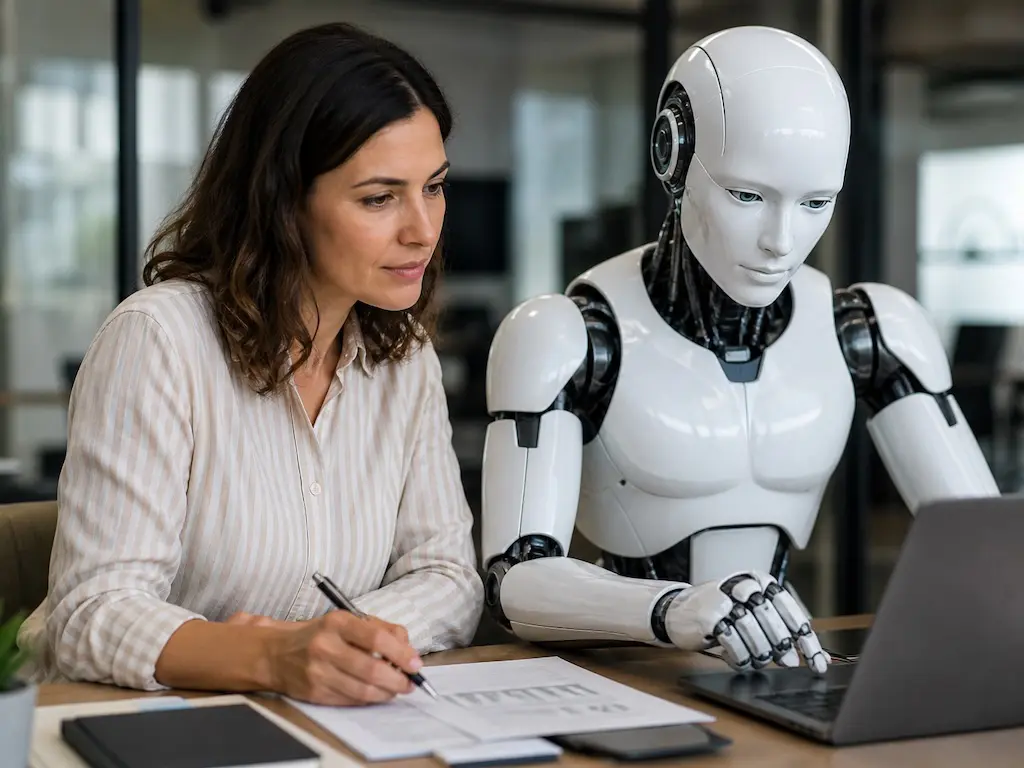
Image created by chatGPT.
Google Docs, spelling and grammar are used to ensure I don’t embarrass myself with typos in a world with no excuses for sloppiness.
I hope you will find these articles a practical resource for your strategic planning. If you’d like to discuss any of the topics covered in this series for your specific context, I’d love to hear from you: mick@micklavin.com
About the author
Mick Lavin is a Systemic and Intercultural Coach, Agile Coach and Mentor, accredited by the European Mentoring and Coaching council. For the past 30+ years, Mick has worked in the world of technology as a people, project, and strategic account manager in several European countries, with the US, in the Middle East, and in Asia. Mick specialise’s in people & leadership development and business agility in multicultural business environments, helping organisations move to a more responsive and people centric mindset.