







































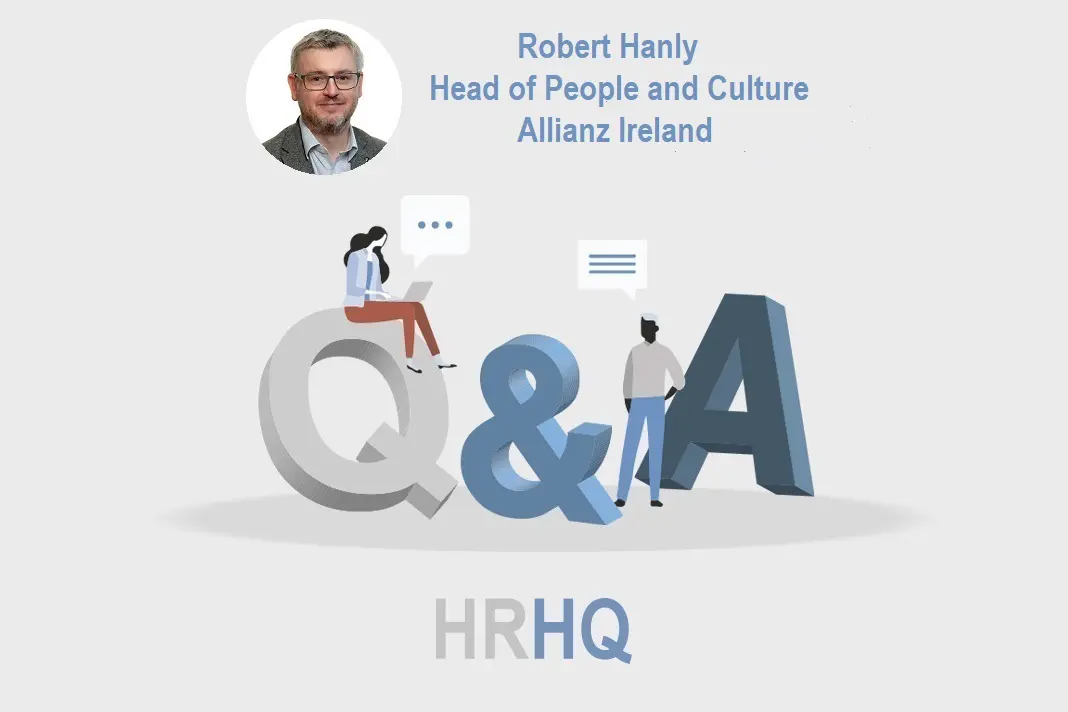
Robert Hanly is Head of People and Culture at Allianz Ireland, employing more than 700 people nationwide. As part of the global Allianz Group, one of the world’s leading financial services providers with 122 million customers in over 70 countries, Allianz Ireland offers a wide range of insurance products in the Republic of Ireland.
We asked Robert to share his thoughts on HR, his career and the challenges facing him and Allianz Ireland.
HRHQ: Tell us about your career journey and what originally attracted you to a career in HR?
Robert Hanly: I started my HR career as a pivot from Psychology, which seemed natural. Because of my statistics experience, I began life in HR as a HR Data Analyst and was very lucky to be spotted and asked to participate in a HR strategy programme. I was lucky again because the approach in implementing HR strategy involved getting very familiar with different aspects of HR very quickly, and I evolved from there, switching between project/specialist roles and generalist experience.
HRHQ: What has been the most significant change in the HR world since you began your career?
RH: There has been lots of change, it’s so hard to pick out the most significant! I think Covid, obviously, in recent times, because it caused many organisations to re-evaluate what really matters in managing their business effectively and sustainably. And just as importantly, it showed leaders how their business was managed in practice. I think it really forced a change both within HR to modernise itself and add value in different ways, and also changed how HR is viewed within organisations.
HRHQ: What is the most important HR challenge facing you currently?
RH: Like many organisations, I believe the biggest challenge is helping people navigate a world that is changing at an unprecedented pace. Every day brings new conversations about AI — some exciting, some concerning — while people are also dealing with economic uncertainty and rapid shifts in the way we work.
For HR, the challenge is not just responding to change, but helping people feel confident and equipped to thrive through it. That means creating an environment where people can focus on what matters for their careers and futures, while developing the skills and adaptability needed for a changing workplace.
At Allianz, our purpose is ‘We secure your future’. For our employees, that means providing secure and sustainable employment, investing in their development, and ensuring they are both AI-ready and adaptable enough to succeed as technology and work continue to evolve. Our role is to help people see change not as something to fear, but as an opportunity to grow.
It’s also about helping people build confidence in their own employability. The skills that make someone successful today may not be the same skills they need in five years’ time, so organisations have a responsibility to create opportunities for continuous learning and growth.
HRHQ: From an employee’s perspective, what does a great HR service mean?
RH: I don’t think it’s any different from a customer, to be honest. People want HR solutions that are easy to interact with, where the activity is quite transactional, and they want comfort and reassurance when it really counts, i.e., in the ‘moments that matter’. AI and digital tools will certainly help deliver the type of efficiency people want and expect for the day-to-day, standard processes, but when people want and need support, I think great HR service is delivered through honest, empathetic and consistent interactions. We are in the people business – I think HR service suffers when we forget that.
HRHQ: How should HR professionals design their career and how much can you realistically career plan?
RH: I believe if you want to get to a senior level in HR, then you have to have a balance between specialist and generalist experience. I spent several years as a HRBP, and think for management you need that experience. But spending time in specialising, even through projects, helps you look at HR through a different lens, and is really worthwhile. When you get to management level, you’ll find that invaluable because a lot of HR challenges require understanding both sides – what can be challenged or scaled back, for example – and how to spot unintended consequences ahead of time.
HRHQ: What advice would you give a person at the start of their HR career?
RH: I’m not sure my advice would be about HR per se, but more about picking the right company. I think many people miss the fact that to get enjoyment from the job and opportunities starting out, you have to be interested in what the company does. It makes a huge difference to understanding what your role is and how you can contribute to that company. When it works out well, it’s because you know that what you’re trying to do, and what the company is trying to do, aligns.
If I had one other piece of advice, it would be to be flexible, to try things out. Everything is a learning experience at the start, and if you’re open to giving things a go, it really gets noticed and will lead to further opportunities nine times out of ten.
HRHQ: What soft skills do you believe are key to progressing your career?
RH: If I had to pick two, the first one would be – just listening. Sifting information is one of the most important things in unlocking understanding, and it’s really, really hard to do when you’re talking. Some people may not think of listening as a skill, but it is and requires a lot of discipline.
The other is negotiation. Where there are two or more people involved in anything, the potential for negotiation exists. It’s human nature. I think being able to negotiate is critical, not just in order to progress things, but also to create trust. When you see people being very transactional and ignoring the relationship, it usually doesn’t work out very well over time.
HRHQ: What experiences should HR professionals try to get as they build up their CV?
RH: I think every HR professional needs to be open to learning and trying new things. I don’t think you necessarily have to leave HR and join a business function at some point, but every HR professional should make the effort to understand their business and have some touchpoint with end customers – it grounds context, and makes your contributions more credible and relevant.
It’s also so, so important to get out of your comfort zone, to do uncomfortable things; as a HR professional, knowing what those experiences feel like always gives you a perspective on how others are feeling and where they need support.
HRHQ: What are you most proud of in your career?
RH: In Allianz, we’ve been fortunate to win the Super Large category of Great Place to Work in Ireland for two years in a row. It’s probably easy to point at that because it reflects how we have really invested in our people and our culture, but we only have these awards because our managers and our people and pretty much everyone at every level has really supported what we are trying to do.
What makes that achievement particularly rewarding is seeing the breadth of people who contribute to it. Building a great workplace isn’t about a single initiative; it’s about creating an environment where people feel supported to develop, contribute and succeed.
Aside from that, personally I’ve had the privilege to watch several people grow in their careers; I think when you look back, it’s people and relationships you have most pride in, and how you’ve turned up and conducted yourself when it matters most.
HRHQ: What is the best part of your job?
RH: I think it’s when we have the opportunity to create things; it’s new, there’s lot of possibility and you have decisions to make. We started a graduate programme four years ago, as an example, and seeing how that has developed, and the experiences and learnings we have gotten from it are great. The graduates themselves bring new energy, and existing people get excited about what they can contribute and add to teams or projects.
Through Allianz, I’ve also had the opportunity to get involved with and support The Shona Project as part of our CSR work. The Shona Project supports teenage girls in navigating today’s world with confidence. It’s an incredible charity, and one that feels more important than ever given the social media environment young women are growing up in. It’s one of those partnerships where you can genuinely see the positive impact being made.
We’re excited to continue building on our relationship with The Shona Project and exploring ways to support its work into the future. Seeing initiatives like this develop and grow is particularly rewarding because you know they have the potential to make a real difference in people’s lives.
HRHQ: What do you think the Future of Work is?
RH: I think a lot of the conversation today focuses on redesigning work for AI, when the real challenge, to my mind, is redesigning work for humans and understanding how AI can enable that. Technology will undoubtedly transform the workplace, but success will still come down to people, their skills, adaptability and ability to make good decisions.
In that future, organisations will need to balance opportunity with responsibility. We will spend just as much time thinking about governance, risk and trust as we do innovation and productivity.
I also think people will become increasingly skills-focused rather than job-focused. Careers will be less defined by titles and more by the capabilities people can bring to different challenges. That creates a real imperative for organisations to invest in learning and development, otherwise skills gaps will emerge quickly as technology evolves.
Perhaps the most significant change will be in leadership itself. Managing teams that are increasingly AI-enabled will require new skills, balancing speed with oversight, innovation with governance, and ensuring technology enhances rather than replaces the human elements of work. The organisations that get that balance right will be the ones that thrive.
I also think organisations will increasingly be judged on how well they help people navigate change. In the future, employees won’t just choose employers based on salary or benefits; they’ll look at how well organisations invest in their development, support their growth and prepare them for what’s next.
HRHQ: Many thanks Robert for taking part and we wish you and Allianz Ireland the very best for the future.